Wispvale began in early September 2026 as a top-down browser adventure: choose a magical companion, build a home, meet the villagers and face a first monster. It grew into a huge browser campaign on paper. Then production moved to a real game engine, so the hero could move, fight and animate like one continuous character. Since then the game has grown chapter by chapter: a narrated opening, a class and companion ceremony, a forest trail, eight creatures that each act differently, two guardian bosses, new music, and a journal that remembers where you stopped.
A second optional route through the woods, one special interaction for each class, and a Windows download to share.
Latest patch notes
These updates come from the same feed as the shelf. The illustrated build history follows below.
· Player visibility
Your hero stays visible behind guardians
A teal silhouette with a warm brass edge keeps your hero easy to track when guardians or scenery block the view, following every move and dodge.
· RPG HUD
Health bars, ability recovery and a clearer view
You and your wish-friend have compact status panels, enemies show health above them, and the action tray shows recovery and magic cost. Guardians show their health, stage and current attack. The pause menu includes party resources.
· Journal bookmark
Player’s journal remembers where you left off
The journal names your safe return point, recaps your progress, and keeps the wish-sprout’s clue once you hear it.
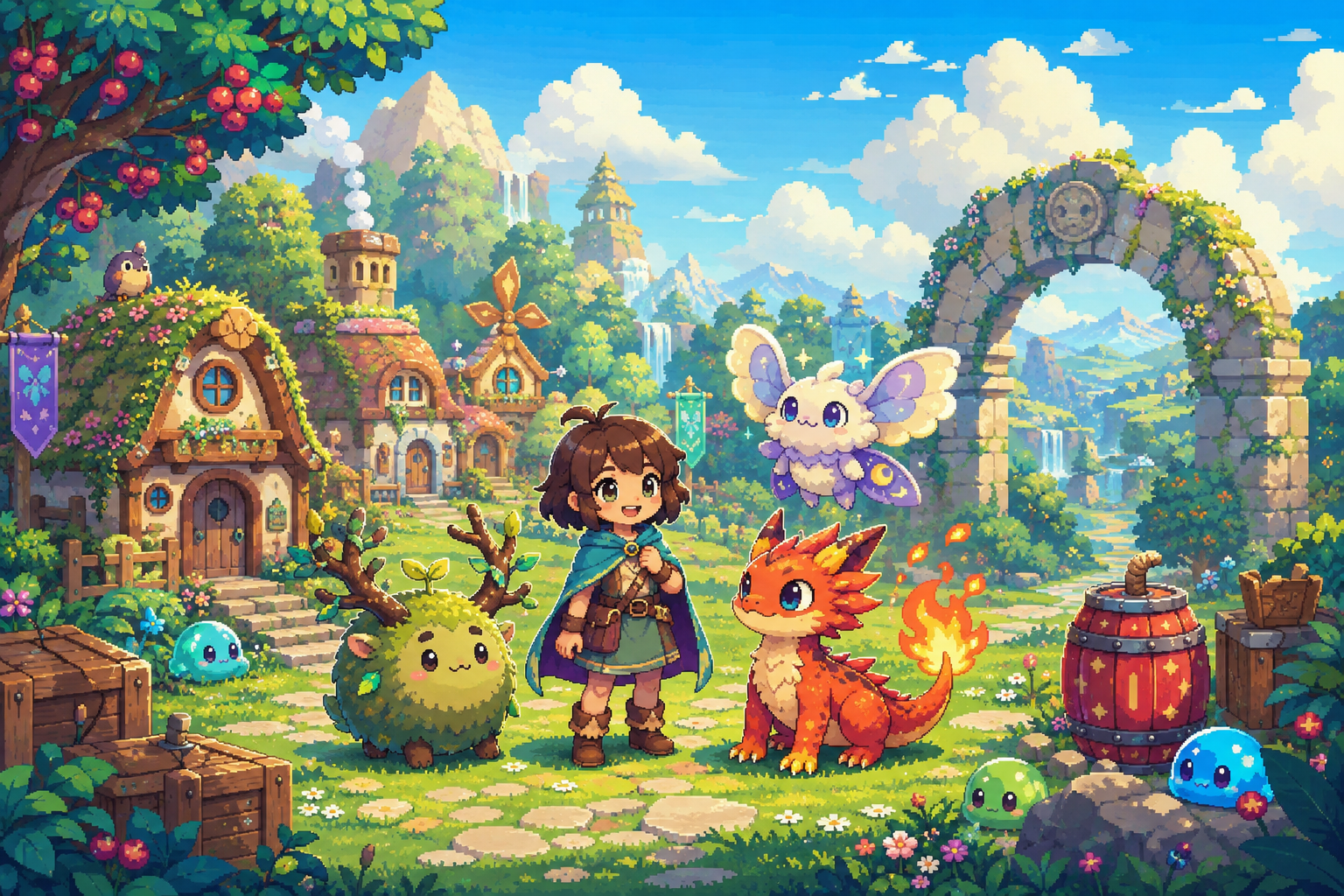
The plan was a warm top-down adventure where the hero picks a companion, builds a home in a living village, takes quests and learns that being kind or selfish both change how the world treats them. The first slice listed a seven-step opening: choose a class and companion, style a house, meet villagers, explore the Sunberry Wilds, make a delivery choice, face a first monster, then return to a changed village. Key art was painted first.
The first key art: the hero with a leafy deer-like friend, a fire creature and a moth friend in front of a cottage village.
2ToyOne rough mechanic, to prove the core is fun.
Turning point
· Browser vertical slice
The first playable game, in one HTML file
The first build was a single offline HTML file under 300 KB with the key art inside it. You could walk, swing, cast magic, gather berries, break crates and barrels, choose a companion and house style, and face the first bounty monster. 15,051 scripted engine checks passed. A browser playthrough could not be automated, so the notes say visual testing was limited.
· Browser campaign candidate
A campaign on paper: 50 maps and five bosses
The design grew into four acts, 16 regions, 50 connected maps, five bosses that change at 65 and 30 percent health, and 25 extra quests with 87 objectives, ending in three possible endings. The notes are careful to say a timed playthrough had never confirmed it lasted multiple hours. This browser campaign later became reference material only.
· Browser v0.2 and 3D art proof
Two browser experiments, then a stop
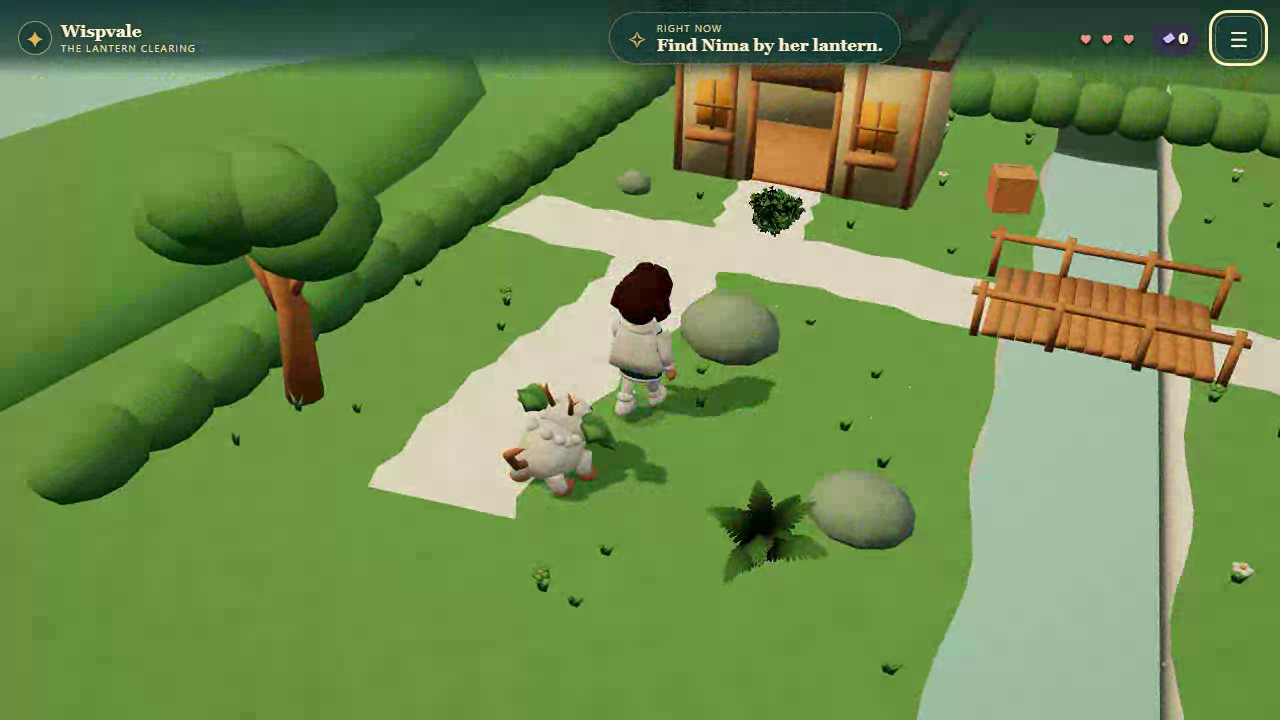
Two browser experiments tried to give the game real 3D: a Three.js art and animation proof with hero designs and a 45-second motion test, and a v0.2 scaffold with a lantern clearing and a cottage. The scaffold was openly labeled a schematic, not a finished release. Both were frozen as reference once the move to a game engine was decided.
Walking the woods in the browser build.An early woodland scene in the browser build.The v0.2 lantern clearing: a cottage, a wooden bridge over a creek and the hero in a green tunic.
Turning point
· Native feel proof
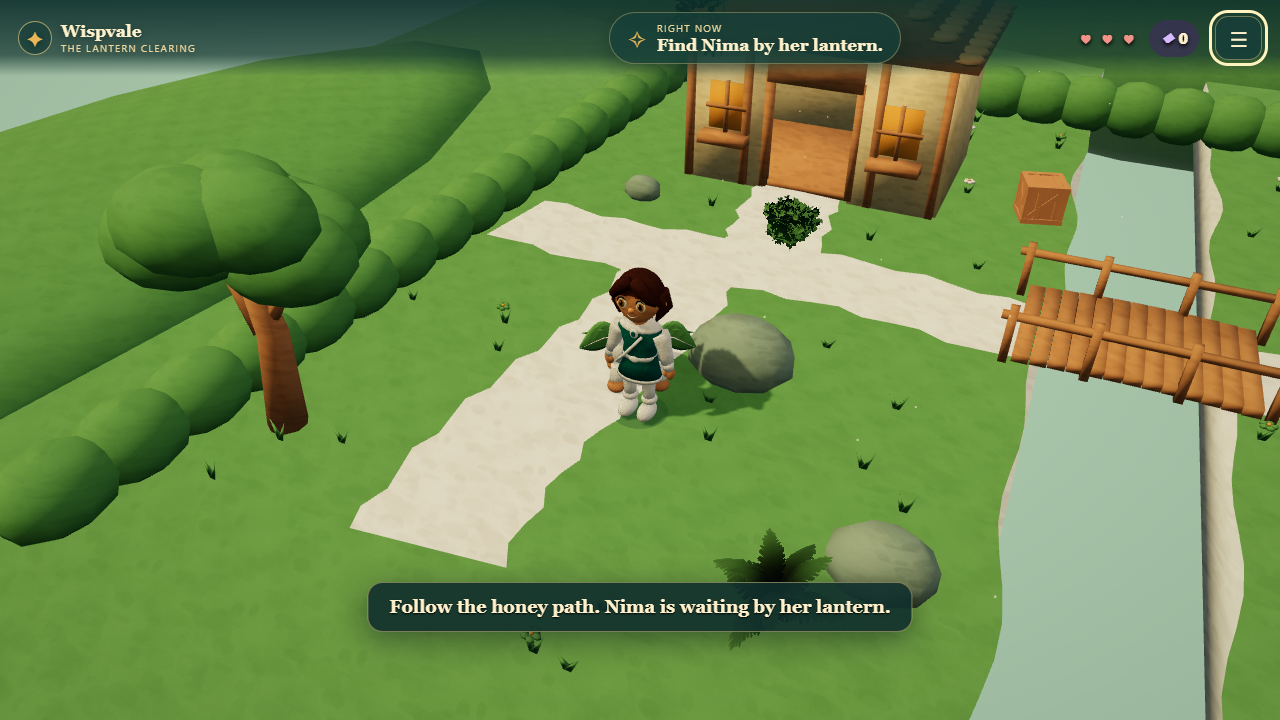
Moving to a real engine: the garden feel test
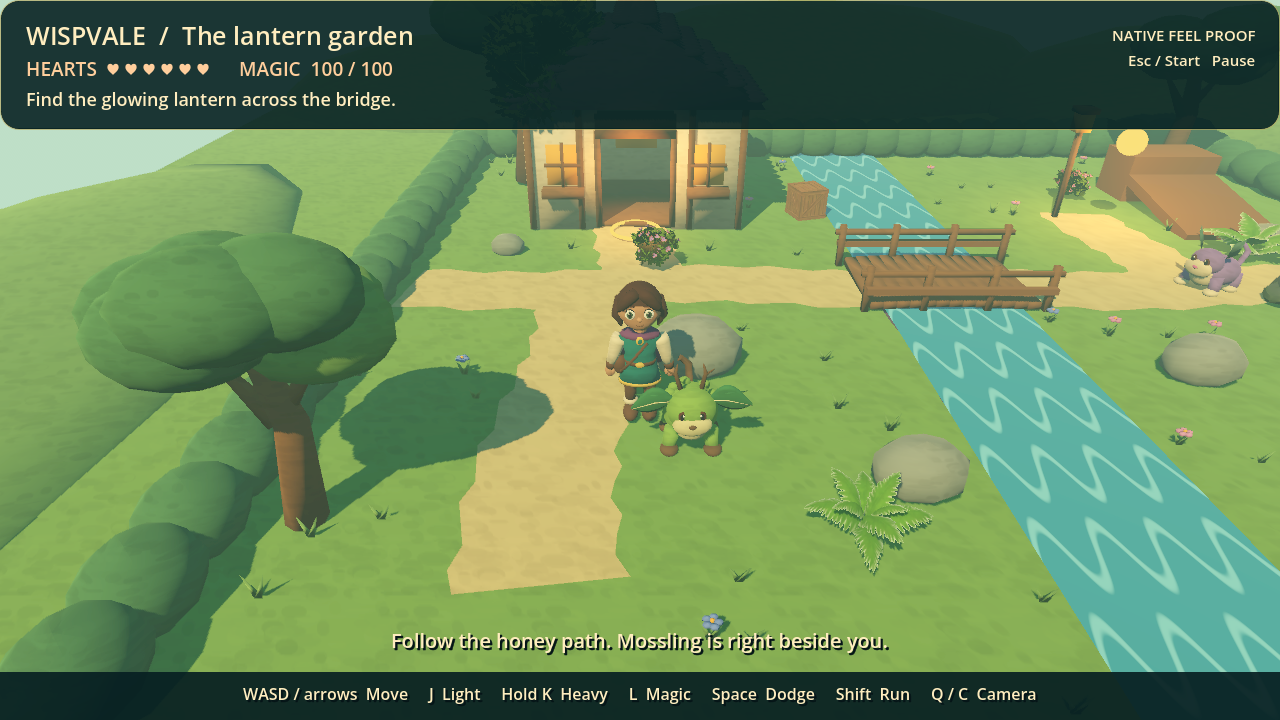
The player decided native Windows and Godot would replace browser production, so the hero could be one continuous 3D character instead of a chain of images. The first goal was only to make moving, running, dodging, magic and a cottage round trip feel good in the lantern garden. The player accepted that look and feel as the base. A bridge that felt like an invisible wall turned out to be a collision step 0.14 meters too high, and fixing it was backed by a test that walks both ways.
The native lantern garden: the hero and a green leafy friend on a sandy path beside a creek and bridge.
3ContentLevels, art and sound go on top.
· Phase I
A narrated opening and the first quest
A title screen now led into twelve painted story panels with spoken narration and a two-minute orchestral opening, then handed control to the hero. The first quest had five steps: cross the bridge, calm the purple tangle, visit the cottage, rest, and return. Steps advanced from real actions like crossing and defeating the creature, not from menu clicks.
Turning point
· Phase II
The Hall of Paths: pick a class and a friend
A third room, the Hall of Paths, let you meet three teachers and choose Guardian, Mage or Ranger, each changing real health, magic, attack and speed. A ceremony then let you choose a wish-friend: Mossling, Cinderkin or Lunamoth, each with its own look and animations that follows you. Saving arrived too, with an autosave every 60 seconds, and five music pieces covered village, woods, cottage, battle and boss moments.
· Creature lab and Mossback Glade
Living creatures: the Mossback Glade study
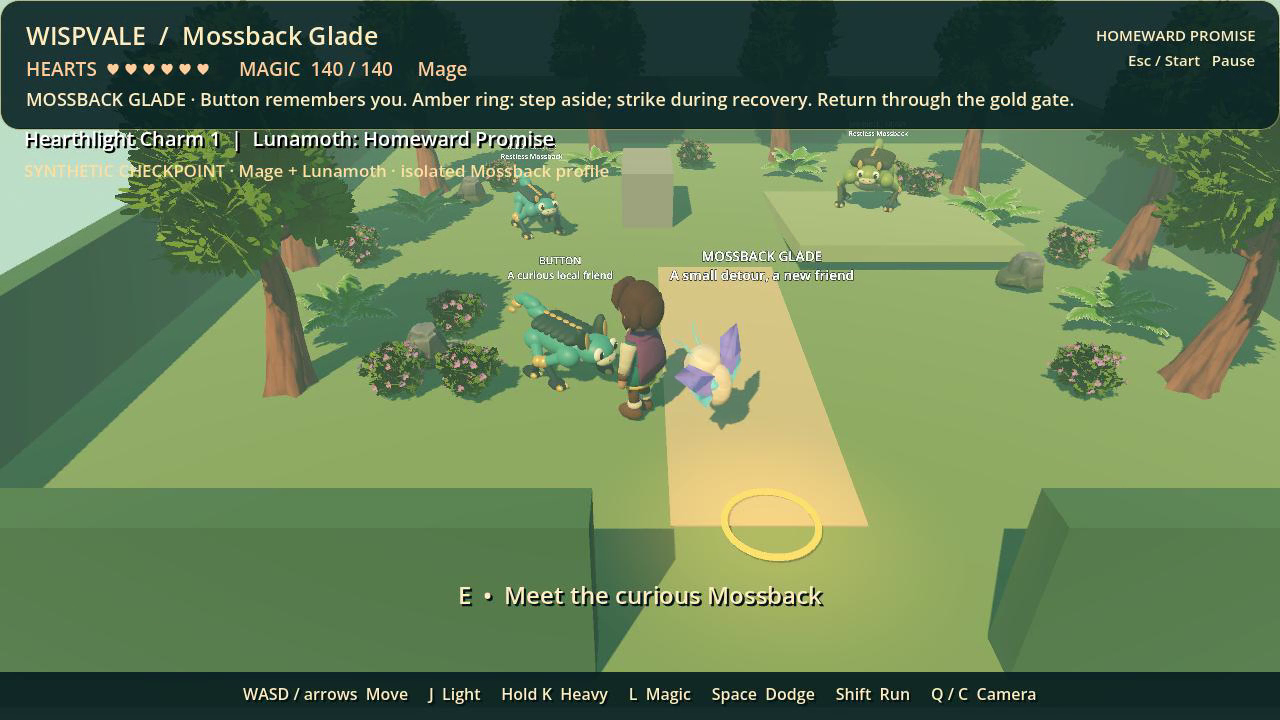
A standalone creature lab built monsters from reusable parts, with legs that stepped to chosen foot targets. A video the player shared was assessed first, and the decision was to borrow its construction techniques without replacing the character pipeline. The lab was then built into an optional playable clearing, Mossback Glade, with two enemy types and a friendly creature to meet.
The early Mossback Glade encounter in motion.Mossback in the early glade scene.
Turning point
· Lanternwild trail
A real adventure: menus, saves and the forest trail
After recovering the project on a new PC, the team added a title screen with Continue and a protected New Adventure, settings, a journal, keepsake equipping and button remapping. The opening got controlled panel movement and a reduced-motion setting. The Lanternwild trail let you wake three waylights, rescue a wish-sprout with your friend, calm the glade, quiet the guardian Bellback and choose one keepsake. A review found controller B could close the book and accidentally dodge, and it was fixed.
· Eight creatures
Eight creatures that act differently
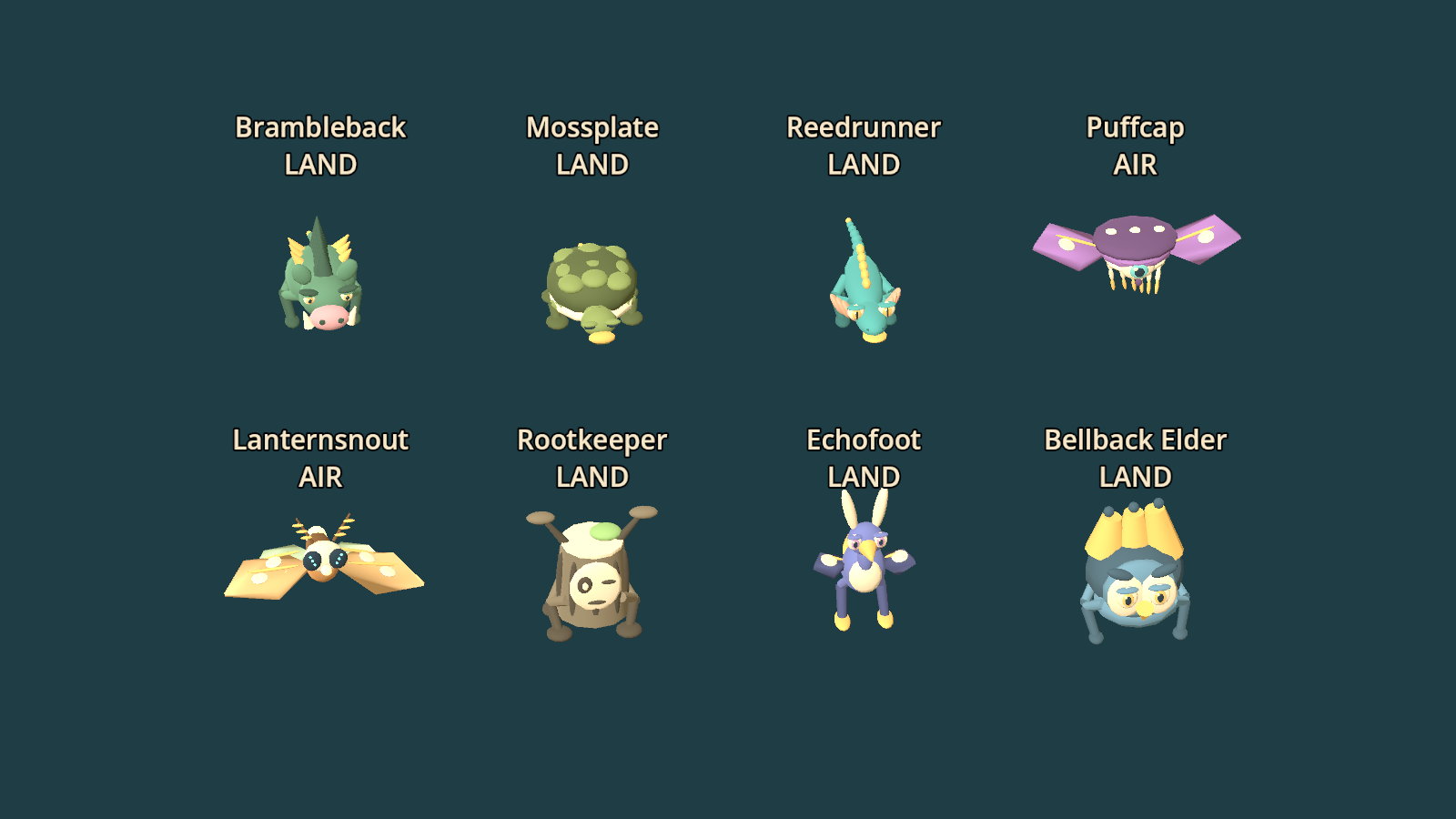
The eight trail creatures were rebuilt with their own faces and body plans: six walk and two fly. You can read about them in a field guide and practice against each one. They were made so each one asks for a different answer, not just more health. A field guide page, a movement preview and a practice mode went in too.
The eight creatures: Brambleback, Mossplate, Reedrunner, Puffcap, Lanternsnout, Rootkeeper, Echofoot and Bellback Elder, marked land or air.
Turning point
· Journal menus and two guardians
A journal that feels like the valley, and two guardians
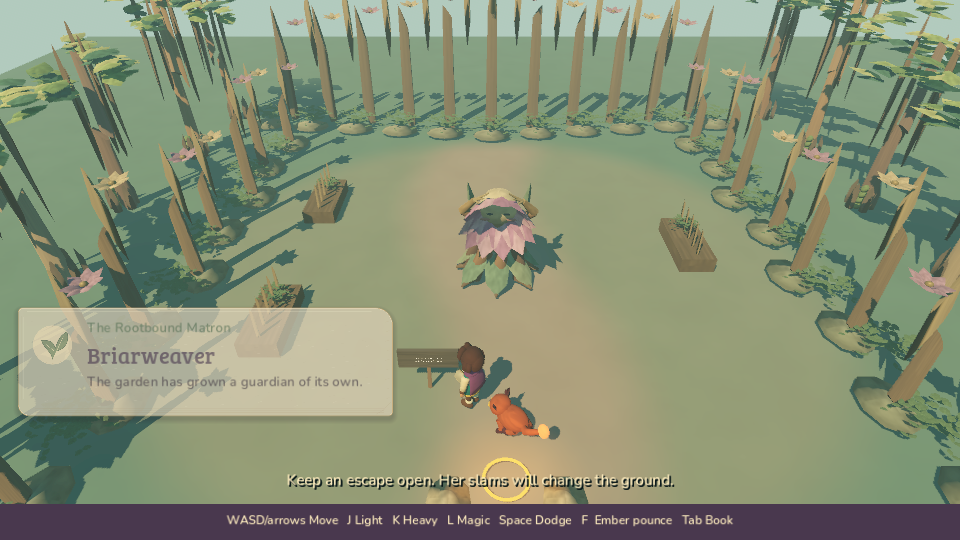
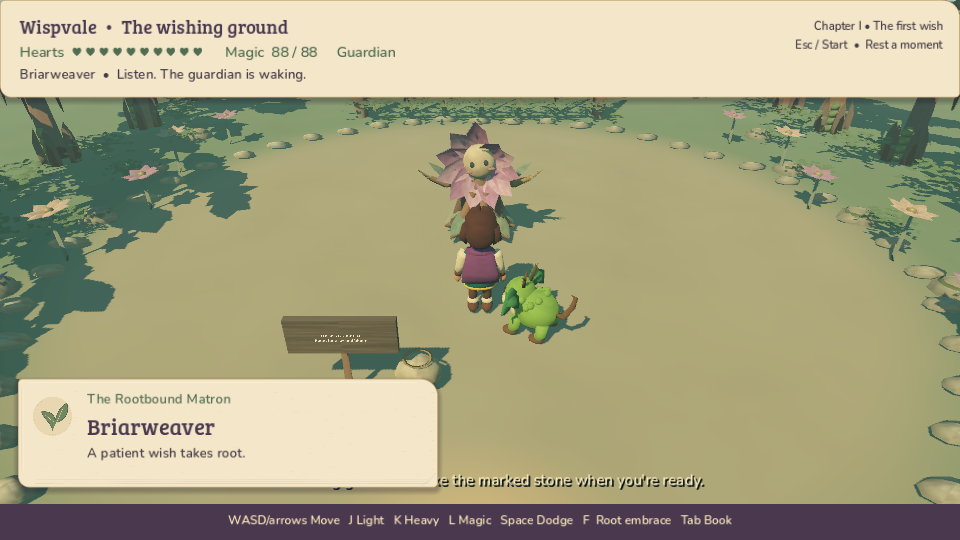
Menus were redrawn as a travelling journal with stitched binding, paper and brass bells. The same care went into the garden, cottage, Hall and woods, with butterflies, robins and ripples. Two proper boss fights arrived: Bellback, Keeper of the Crown, and Briarweaver, the Rootbound Matron, each with its own arena, warned attacks, a second phase and a 3.2 second entrance. The menu look was also exported as a reusable kit.
Briarweaver in a ring of tall roots as the hero and a fox friend approach.
Turning point
· Guardian threat pass
The guardians get bigger and meaner
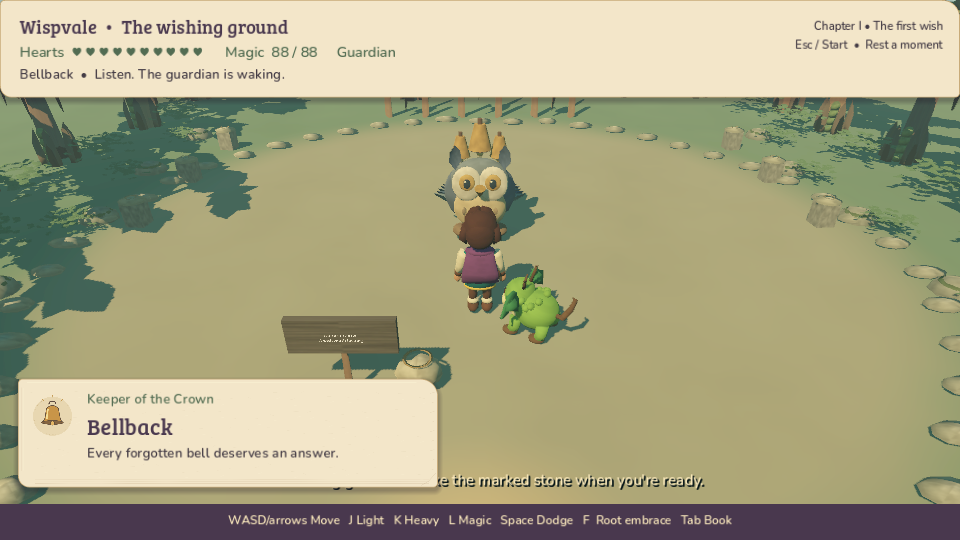
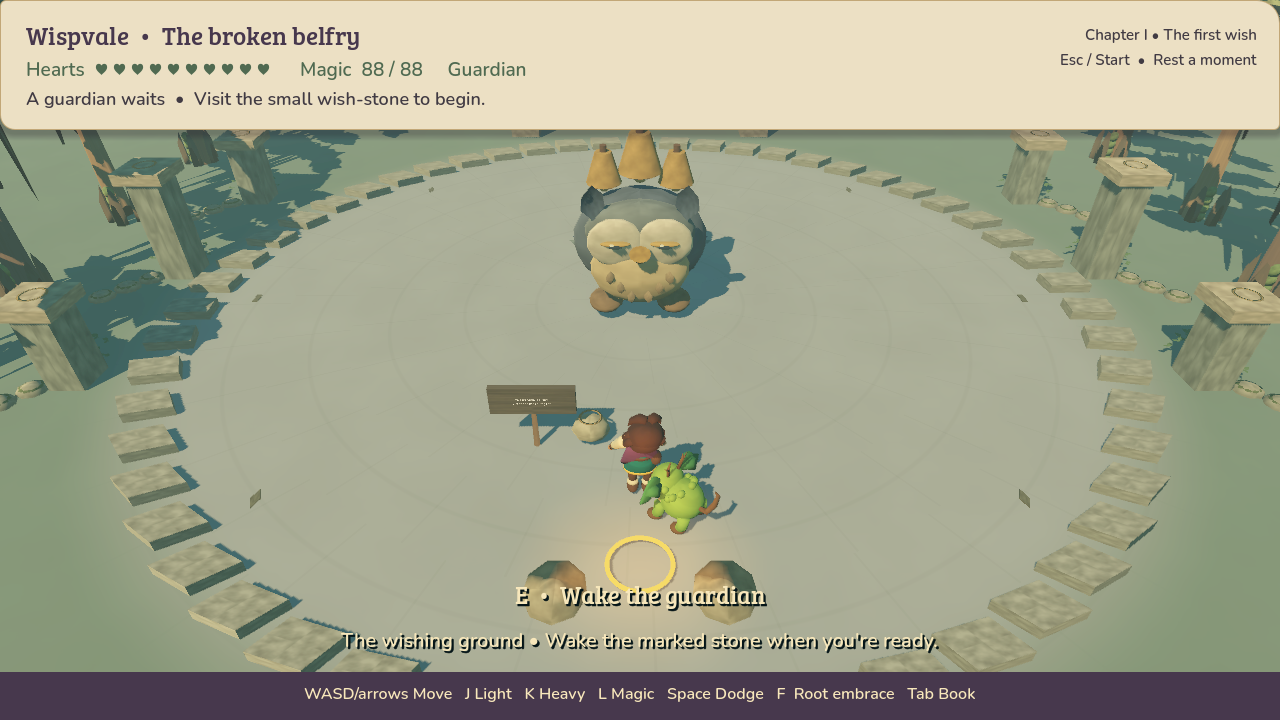
Both guardians became 1.9 times larger, with three stages and their own broken arenas. Bellback sends traveling wave crests with changing gaps, and heavy slams push and knock you down and leave craters with two ways through. Bot fights at ordinary health could finish every stage, but the notes say this proves it can be finished, not that it is balanced for people.
Bellback enters the arena.Briarweaver enters the arena.Bellback framed by the woodland arena.Briarweaver framed in the native encounter.Bellback, a large owl-like guardian with brass bells, waiting in its stone arena.
· Action audio
New music, and the grunts were cut
Each area and each guardian got its own music, and combat music now follows actual enemies chasing you, with a 2.5 second release after the last threat. Settings split into Music, World and effects, Spoken voices and All sound. The first set of 14 breath and effort sounds for the hero did not sound right to the player, so all 14 were removed and replaced by recorded cloth, leather and impact sounds.
· Briarweaver payloads
Briarweaver throws seeds, stones and roots
Briarweaver now lobs ribbed seed pods through the air, drops larger Uproot stones with a matching landing thud, and cracks the ground before roots erupt. The pause between root beds was set at 1.35 seconds and between crossing arms at 0.40 seconds. The player approved this version on 2026-11-05 and it became the baseline.
· Where the Roots Remember
Learn the roots before you fight the matron
A new root lesson sits on the trail: listen at a stone, then practice clearing root circles and crossing the marked lanes. Passing it opens a gate to the root amphitheatre and the three-stage Briarweaver fight. Each wish-friend also gets a choice of bond, Quick Pulse for a faster command or Deep Bond for a stronger one. A scripted run cleared all three stages in 58.7 seconds.
· Toolkit trials
A test fooled itself, and was fixed
A check of the trail reward failed because the test hit the guardian for 100 damage when he had 144 health, so he never reached the reward step. The test now uses his real health and runs his real defeat code: the keepsake choice opens, a second claim is rejected and restoring a finished game gives nothing twice. 40 of 40 trail checks and 93 of 93 full adventure checks passed.
· Journal bookmark
The journal remembers where you left off
The journal now shows a Where I left off card naming your safe return point, recaps what you did, and keeps the wish-sprout clue once you have heard it. The adventure check passed 131 of 131 and the trail check 40 of 40.