THE FREE MAGAZINE FOR MAKING GAMES WITH AI!!ISSUE 01 · NOVEMBER 2026

652 FREE TOOLS12 GAME KITS72 QUICK ANSWERS643 IN THE ORIGINAL SWEEP

ISSUE01NOV 2026
PRICE: FREE
LOADOUT-01 · NOV 2026

What are you making it for?Flip it. Every badge in the issue follows.

Free hobby games for you and your friends. Almost every tool is fine here.Sold, ads, or on a store. Badges now show the selling license, and every catch gets a warning.

02ContentsPAGE 02

In thisissue

02LOADOUT · November 2026Contents

04Strategy GuidePAGE 04

Pick your
game.

Twelve kinds of game, twelve short kits. Find the one closest to yours and set up only that. Every kit says what to use, what to try first and what to grab only if you need it.

Loading the kits...

04LOADOUT · November 2026Strategy Guide

18Cheat SheetPAGE 18

I want
to...

Seventy-two quick answers from the study. Type what you're after, like music, dialogue or Game Boy, and the file narrows down.

File 18 / quick answers72 entriesChecked 2026-11-05

Showing all 72

18LOADOUT · November 2026Cheat Sheet

22CROSSCHECKPAGE 22

Two judges, one from each team, looked at the same evidence for 192 design-side tools: shipped games, showcase art, sample outputs and UI screenshots. Neither saw the other's calls. These are their real verdicts, word for word. No scores were made up for this page.

192design-side tools judged
138got the same verdict from both
128got the same tier from both
38Claude said MEETS, Codex said CONDITIONAL
13Claude put below the bar
26picks both teams agreed on

The verdicts

MEETS
meets the design bar
CONDITIONAL
good, with conditions
BELOW BAR
below the bar for the kit

The tiers

core
use it on most games
often
a regular
situational
when a game calls for it
one-off-cool
fun for one project
skip
leave it on the shelf

Both-team picks

ALWAYS
use it every time it fits
SOMETIMES
when the game needs it
ONCE
worth one try, because it's cool

Matching calls show agreement on the same evidence, not how well a tool will work in your game. Only a real asset in a real game shows that. Where the judges split on tier, the kits use the more cautious call.

Loading the verdicts...

Field Tests: tools we actually ran

CROSSCHECK's original verdicts came from evidence reviews. These reports put tools into a real workflow and show what happened.

TESTED · NOV 14, 2026

3Dviz Pro Max

A fact checklist for your AI's 3D scenes. We built three small games with it. Right chemistry and left-right bones, but not faster. Skill scores 2, 2.5 and 2 out of 5. Play all three.

Windows · headless Chrome. Needs python, not python3.

Read the 3D test

TESTED · NOV 13, 2026

ASCII Magic Art

734 animated pieces drawn in letters. 733 passed the built-in check. Six ran at once on a self-hosted page with no outside requests. We built a small playable room on its kit.

Windows · headless Chrome. Godot and real phones untested.

Read the ASCII test

TESTED WITH A FIX · NOV 11, 2026

Polyfork in Godot

A useful low-poly parts bin. Four imports matched their geometry metadata, but materials needed a color flag correction. Tested color-only GLB requests kept default paint.

Windows · Godot 4.7.2 · Compatibility/OpenGL · Quadro RTX 5000. Android and performance untested.

Read the Polyfork test

TESTED COMPARISON · NOV 8, 2026

One lantern, two normal maps

Pixel Art Lighter kept a painted letter flatter than Laigter's default normal map. One 48 × 48 sprite, the same moving light, thirteen rendered positions.

Windows · Godot 4.7.2 · Compatibility/OpenGL · Quadro RTX 5000. Other sprites, masks and Android untested.

Read the lighting test
All field tests

What the judges found

Both agree

The spine is Krita, Blender, Inkscape, Pixelorama and Godot. Both raised Effekseer for spell and hit effects. Hero work stays bespoke: the player, bosses, title screen and menus never come from a pack or a generator.

Codex is stricter on MEETS

For 38 tools, Claude's judge said MEETS and Codex's judge said CONDITIONAL. Codex wants proof of repeatable production quality, not one good sample.

Claude is stricter on BELOW BAR

Claude's judge put 13 tools below the bar, including retro web UI kits like NES.css, the LPC character generator, raw SDXL output, RIFE and TripoSR. Codex held them at CONDITIONAL, because weak examples alone don't prove a low ceiling. Both moved them out of the kit.

The safe look, and seven fixes

Editors and engines meet the bar. Packs, presets, templates and AI generators are where the "safe" look comes from. That's what both judges found, working apart. Here is how a kit makes the safe look, and what to do about it.

1

Defaults survive

The gray template menu, the stock dialogue box, the default Godot theme, stock particle presets, Inter everywhere. Each is competent and none has personality. Fix: a "no default survives" rule. Before any look review, ask which defaults are still visible.

2

The asset casserole

Kenney, KayKit, Quaternius and the pixel packs are great and instantly recognizable. Mix three and the rooms look like they came from different games. Fix: one source family per game, repainted to the palette, relit under one light, and the hero set always made for the game.

3

AI averaging

Generators drift to the middle: stock props, sprites that are pixel-styled rather than pixel-made, faces that change between frames. A beautiful sample hides a broken back side or a drifting walk cycle. Fix: AI for concepts, paintovers, textures and distant props only. Require a character sheet, several views and an in-engine playback before an asset is accepted.

4

Filter soup

Bloom, vignette, scanlines and noise on everything make a dim, muddy, dated image, and loud effects can make a weak attack feel bigger without making it threatening. Fix: write one lighting idea per scene first, and build anticipation, contact and recovery before adding effects to explain those moments.

5

Same juice on every hit

Preset shake on every hit reads generic. No hit-stop and tiny tweens read safe. Both miss weight and threat. Fix: a feel spec per action (anticipation frames, hit-stop in milliseconds, knockback, shake by attack weight), bespoke telegraphs for bosses, and review in captured video.

6

"Apply palette" is not art direction

Automatic snapping keeps the shapes and crushes the ramps. Fix: assign shadow, mid and light per material by hand, then check labels, danger states and silhouettes at the smallest size they appear.

7

Passing checks ends the design work

Materials that import and animation tracks that validate say nothing about character or feel. Fix: review one full encounter and one full menu against a written visual target, then polish the weakest visible thing.

Before any game's first look reviewOne art direction sheet (hero, ordinary enemy, a boss that feels dangerous, an environment corner, a menu), one written lighting idea, three type roles, a palette with hand-assigned roles, a feel spec per action, and a credits file started on day one. Then judge it in motion, at the real camera distance, on the real screen.

22LOADOUT · November 2026CROSSCHECK

28Buyer's GuidePAGE 28

Buyer's
guide

Every tool the two teams checked, all free to use, each with a license note. Pick a job from the key, narrow it by kind of game, and flip the cover sticker to see the selling license. Reference projects stay hidden until you tick them.

KEYColor means job. Tap one to filter, tap it again to clear.

How much you need it

Loading 653 tools...

28LOADOUT · November 2026Buyer's Guide

40Special ReportPAGE 40

What wins,what flops

How people are making games with AI right now, what they make, and where the money really goes. The numbers come with their sources.

Who's shipping what

Most AI-made games right now are small. One person points a coding agent at real project files, plays every build and keeps the scope tight. Browser toys and jam entries make up the biggest crowd. A thinner stream of survivors-likes, tower defense and twin-stick shooters reaches Steam.

The builders are a mixed bunch. Vibe Jam drew over 1,000 entries in 2025 and 945 in 2026, when its rules required at least 90% AI-written code. The 2026 winner had about nine years of iOS work behind the game. Steam has a backend developer new to games, solo devs and small teams running Claude Code and Codex side by side. Parents build with their kids. Non-coders use hosted makers like Astrocade and Rosebud, whose big player counts are company claims.

Vibe Jam 2026 press page2025 jam results

The code tools, as sightings

None of the sources ranks these tools on a fair test, so read this as who shows up where. In one February 2026 snapshot of r/aigamedev, Claude came up in 15 of 87 readable posts, Codex in 9, Gemini in 8, ChatGPT in 3 and Cursor in 1. That is one day on one subreddit, counting mentions. Shipped games line up with it. Claude Code built the 2026 Vibe Jam winner and Codex Mortis on Steam. fly.pieter.com credits Cursor and Three.js. Codex often runs beside Claude.

People mix models freely. One writes code, an image model draws concepts, Suno makes music and ElevenLabs makes sound. In one forum thread, usage limits drove tool switching more than quality did. Codex's own research found no broad, current benchmark that crowns a winner. Running Claude Code and Codex on one project matches what the shipped examples use.

r/aigamedev snapshot (mirror)Codex Mortis on Steam

Engines that suit agents

This is workflow fit, judged from file formats, headless runs and builder reports. None of the sources measures engines head to head. Agents do best when the whole game is text they can read and a build they can run and look at.

Native: Godot + GDScript

Scenes and scripts are plain text, and the engine runs headless. JAMER, SWE-Game and GameCraft-Bench all test on Godot, and JAMER says it chose Godot for those two traits. The common bug is Godot 3 code in a Godot 4 project. Choose GDScript whenever a web build might matter, because Godot 4.7 can't export C# projects to the web.

Browser: Phaser 4, Three.js, Babylon.js

Code only, with no editor state to lose. Phaser 4 ships 28 skill folders for agents, including a v3-to-v4 migration skill. Three.js publishes an llms.txt that tells models which import pattern is current. Old-version code is the usual bug, so pin versions.

Editor-heavy: Unity, Unreal

Agents reach these through bridges that drive a running editor, because scenes live in binary files or YAML full of cross-references. It can work. Infinite Night reached Steam with Claude Code and a Unity MCP bridge. This kit still skips Unity on cost and license grounds.

Godot 4.7 web export docsJAMER paperPhaser repo and skills

What the benchmarks agree onAgents do well on small, testable pieces and poorly on big architecture. In JAMER, runtime pass rates fell from 80.4% on small Godot projects to 5.7% on large ones. In GameDevBench, letting a model see screenshots and video of the running game raised it from 41.1% to 52.0% of tasks solved.

What they make

  • Browser 3D arcade toys such as flight, driving and delivery games, often multiplayer
  • Daily web games with a score to share, like Dialed's color memory games
  • Survivors-likes and twin-stick shooters (Codex Mortis, Swarmbreak)
  • Tower defense, autobattlers and small RTS games
  • Idle games, often about vibe coding itself
  • Free mobile casual games with ads
  • ARPGs, shooters and MMOs, started often and rarely finished
  • Web ports of famous games, which draw DMCA notices

Where it goes, how it earns

  • A free web link with sponsors and upgrades. fly.pieter.com sells an in-game F-16 for $29.99.
  • Display ads. Dialed's creators report "low 5 figures" a month, and commenters doubted it.
  • Jam prizes. Vibe Jam 2026 paid $40,000 in main prizes.
  • Cheap Steam releases. Codex Mortis costs $3.99.
  • Phone stores with ads, usually for very little.
  • Web portals on revenue share. Poki may ask to see your prompts.
  • Hosted feeds. Astrocade says it pays creators by play time.
  • Family games, which earn nothing and need nothing.

What wins, what flops

The AI label is common on Steam now, and the money mostly goes elsewhere. The games that work keep AI out of the first impression, stay small and have a person checking whether it's fun.

About half of new Steam games released in October 2026 disclosed AI content (50.9% by Sulka Haro's count, 49.9% by another), up from about one in three in Q2 2026 and 42% in the most recent full quarter, yet AI-disclosed games took only about 10 to 12% of estimated sales in those quarters (Haro, July and November 2026, review-based estimates).

50.9%

October 2026 Steam releases that disclosed AI, 1,982 of 3,897.

10 to 12%

Estimated share of Steam sales those games took, from review counts.

83 to 92%

Share of AI-game revenue the top two AI titles take in each mature quarter.

Most of the money sits in big, ordinary games with light AI use. Ichiro Lambe roughly estimated $660M gross for 10,258 AI-disclosed games by November 2025. Twelve made eight figures, and 9,556 made under $10,000.

The label travels with fewer reviews. AI games reach 100 reviews at about 0.55 times the rate of other games. A vendor study of 9,879 paid games found 52.6% fewer first-month reviews after controls. Both are associations, and neither proves the label causes the drop.

Art is what players see first, and it shows up more in the flops. Among AI-disclosed games, 72% of flops mention AI art against 57% of successes. In October's Next Fest, 2 of the top 25 demos disclosed AI, against 35% of demos ranked 101 and below.

Haro, November 2026Haro, July 2026Zukowski on Next Fest

When AI is the game

The few wins make a weird answer the fun. Infinite Craft caches every combination, so repeats cost nothing. Death by AI reports 20 million players in three months, a figure from the vendor that sells its AI. Story games built on open chat NPCs mostly land at Mixed, with Suck Up! at 62% and Vaudeville at 47%.

Hosted platforms can take your game with them. Gambo AI shut down in May 2026, and only exported games survived. Rec Room closed on June 1. Research firm Sacra says one Maker AI user cost more than a Plus subscriber's net revenue, while Rec Room blamed the VR market and wider gaming headwinds.

The solo money stories

Every revenue number for a single AI-built game comes from its creator or a vendor, and none has been checked independently. Pieter Levels posted that fly.pieter.com hit "$1M ARR in 17 days," an annualized run rate from a strong launch month. His own projects page, updated November 3, 2026, files it under "Okay: Took off, Made money but not sustainable."

The typical result is far smaller. One builder ran a one-person Claude Code "studio" with 15 subagents, shipped 7 Android games in two months and earned 152 yen in ads over 30 days, about one US dollar. Infinite Night passed Steam review in April and shows no user reviews as of November 5.

Levels' projects pageThe seven-game write-upRec Room report (IBTimes)

What separated the winners

1

An audience before launch

Next Fest's top 25 demos had a median of 5,519 followers before the fest. Rank 101 and below had 15. The seven-game builder wrote that "the department setup did nothing for getting found."

2

A person checking fun

The Vibe Jam winner playtested constantly. The seven-game studio checked nothing for fun until it added a critic agent.

3

Small scope, forgiving art

Instant play, no login, low-poly looks. Flops chased ARPGs and MMOs or shipped raw AI art.

4

Skill from somewhere else

Winners brought years of app or engine work. Emilio Coppola of the Godot Foundation told Kotaku that "coding is rarely the roadblock in making a successful game."

Openings for you

A

Family games skip the store fights

A game for your family skips store politics and review penalties. Keep AI at build time and out of runtime chat. Wholesome and Cozy are Steam's least AI-heavy tags (6% and 10%), which hints that this audience prefers handmade work.

B

Party games for the couch

Local Co-Op is another low-AI tag at 11%. If an AI judges the game, cache its answers or run it locally so game night has no cloud bill. Ikemen GO is a free fighting game engine for a home arcade cabinet.

C

Retro games for handhelds

Pixel Graphics sits at 12% AI. Godot APKs sideload to Android handhelds, and GB Studio makes real Game Boy ROMs.

D

Jams that welcome agents

Ludum Dare and Global Game Jam allow AI tools, and Vibe Jam requires them. Most itch.io jam series now ban AI assets. In 11 recurring series, 94% of 2026 entries ran under a ban.

The fuller numbers behind this report
  • Lambe's bands. His method multiplies reviews by price by 35, which he calls "the roughest back-of-the-envelope calculation." The eight-figure list reportedly includes Stellaris and Call of Duty: Black Ops 6.
  • The review study. Game Oracle, a Steam analytics vendor, studied paid games from January to October 2025 and controlled for genre, month, publisher and developer history. It is observational and not peer reviewed.
  • Ratings. AI games average 76.4% positive against 81.5%. Among games with 1,000+ reviews the gap is small and flips between samples (82 against 84 on 46 games in October, AI slightly ahead on 27 games in July).
  • Haro's definitions. A success has 1,000+ reviews (138 games). A flop has under 50 reviews after nine months or more (a random 400). Successes also disclose AI voice (24% against 8%) and localization (18% against 6%) more often than flops.
  • After-launch flags. Haro found 22% of successful AI games added their disclosure after launch.
  • Next Fest. 34.6% of 7,240 demos disclosed AI, and only 0.3% of disclosing demos called themselves substantially AI-built. Zukowski calls his ranking preliminary, and a correlation is not a cause.
  • Sales estimates. All sales shares come from the Boxleiter method, which turns review counts into sales. Haro calls it poor for any single game, so none of these is one game's real earnings.

Lambe's $660M estimateHaro, Part 2Review penalty study (PC Gamer)

AI as gameplay, and the platform cases
  • Death by AI. 10 million players in month one and 20 million in three months, plus "now profitable" with no figures. All from Inworld, which sells the tech.
  • inZOI. Krafton says it sold over 1 million copies in its first Early Access week. Steam shows 79% of 14,625 English reviews.
  • Suck Up! 62% of 228 reviews. Vaudeville 47% of 287. AI Roguelite 82% of 617.
  • History Simulator: Chongzhen. Launched at 48 yuan plus per-token charges and later went free. Its 1,200+ reviews sit at about 54% (the article says 56% in one place), with most complaints about pricing. The developer reports 75.1% day-two retention.
  • Whispers from the Star. Very Positive, 80% of 1,666 reviews, with a reported day-one peak of about 964 players. Loved and small.
  • Where Winds Meet. Players skipped quests by talking its chat NPCs into handing over the answer (reported).
  • Rosebud. The free tier carries no commercial rights, and code export starts at $50 a month.
  • Astrocade. The CEO says it grew from about 5 million to 10 million monthly players in four months. Company claims.

Death by AI (vendor)Chongzhen (36Kr)Gambo AI shutdown

More small, honest cases
  • Codex Mortis. $3.99 on Steam. Its early period sat at Mixed, 60% of 10 reviews. Today it is Very Positive, 81% of 96, a small audience.
  • Infinite Night. Its creator says it took ten days. Released April 9, 2026, it has found almost no players.
  • Pixel Darts. 202 copies and $1,165 in lifetime gross against about $600 in AI and software costs, from the creator's screenshot. Not independently checked.
  • Unmotivated Heroes. About 50 to 60 copies in its first Early Access month.
  • The 2026 Vibe Jam winner. $25,000 prize. He had the AI build a map editor, road editor and debug panel. Creator-reported build: 27,000+ lines, 188 commits, under $150 in tools, about two weeks.
  • Dialed. About 30 million plays across four games in 90 days, by the creators' own numbers.

Infinite Night on SteamPixel Darts numbers

Store, award and jam rules that matter
  • Steam. Disclose AI content that ships with the game or is generated live. Valve says efficiency tools are "not the focus," so coding help needs no label.
  • Poki. No chat systems of any kind, no raw AI output, and be ready to show your tools and prompts.
  • Playdate Catalog. Since April 2026, no gen AI for art, audio, music, text or dialog. Code help is allowed with a flag in the main Catalog.
  • Newgrounds. Bans games generated from an AI prompt and AI-made thumbnails, as Codex's research reports. The checker could not open the page.
  • Crackdowns. November 2026 headlines say itch.io deleted "a couple terabytes" of AI uploads and Valve tightened submission checks. The article bodies were not read.
  • Indie Game Awards. Clair Obscur: Expedition 33 lost Game of the Year and Debut Game after AI placeholder textures shipped in it.
  • Arc Raiders. AI voices drew anger, and the game still sold over 12 million (12.4M per Nexon, January 13, 2026). Embark re-recorded some lines with actors.
  • Ludum Dare. AI tools are allowed. Opt out of a category if about 90% of its work came from a generator.
  • The jam trend. Share of entries under AI bans in 11 recurring series went 0% in 2021 and 2022, 6% in 2023, 28% in 2024, 89% in 2025 and 94% in 2026.

Steam content surveyPoki AI rulesJam rules dataset

What players and developers say

GDC's 2026 survey found 52% of industry respondents think gen AI harms the industry, up from 30% in 2025 and 18% in 2024. GameDiscoverCo asked about 3,800 players and found 43% fine with AI, 31% negative and 8% who would never buy, and 56% want coding tools disclosed too. Quantic Foundry found 85% of 1,799 gamers below neutral on gen AI in games. The surveys ask different questions. Sales data shows a real penalty and no boycott.

The code tool evidence, with its limits

The r/aigamedev snapshot is one day of one subreddit, read through a mirror because Reddit blocks automated reads. It counts posts that mention a tool. Shipped games are a separate question. It also puts Codex second for 2026, ahead of Cursor.

  • The 2026 Vibe Jam winner, A Game About Capybaras Delivering Food, used Claude Code (Opus 4.7), Three.js, Tripo3D, GPT Images 2, Grok, Suno and ElevenLabs. He won $25,000. His build stats come secondhand from his own write-up: 27,000+ lines, 188 commits, under $150 in tools and about two weeks.
  • Codex Mortis used Claude Code, TypeScript, PixiJS, bitECS and Electron, with ChatGPT for art.
  • Imperium (creator-reported) ran Claude Code sessions in separate Git worktrees, a custom bridge that loads saves and takes screenshots, and headless balance simulations, over about 2,500 commits.
  • PARALLAX (creator-reported) paired Claude Code and Codex with a human artist-writer, a developer and a project manager.

Lovable, Replit, Windsurf, Copilot and Bolt each have a prototype or two on record, such as a father and son's Minecraft-themed learning game made with Copilot. No paid commercial release turned up for any of them.

In GDC's 2026 survey of 2,300+ industry people, 36% use gen AI at work and ChatGPT led the tool list at 74%. Code help was a use for 47% of those AI users, roughly 17% of everyone asked. Unity's 2026 report says 62% use AI for coding help, but it surveyed Unity users. Cursor was Vibe Jam 2026's title sponsor, so the jam's tool advice comes with a sponsor attached.

GDC 2026 surveyCapybara winner write-up (36Kr)fly.pieter.com

The benchmark numbers in full
  • GameDevBench. The best agent solves 53.8% of tasks. Gameplay tasks succeed 51.4% of the time against 33.0% for 2D graphics. Visual feedback took GPT-5.4 from 41.1% to 52.0%.
  • JAMER. Runtime pass rate 80.4% on small Godot projects, 5.7% on large ones. The authors say the "bottleneck lies in architectural design."
  • SWE-Game. 247 Godot tasks. The best whole-game construction score is under 60 out of 100 (50.38 on Brief-to-Game).
  • GameCraft-Bench. 140 Godot tasks. The best agent scores 41.46%.
  • A Godot forum postmortem. 40 hours over two months on a metroidvania, then the author gave up. The agents "can't handle more than 2-3 scripts at a time." The tools were Gemini, Replit, Cursor, Google AI Studio, Continue and Cline.

GameDevBenchSWE-GameGameCraft-BenchGodot forum postmortem

Engine notes and traps
  • Godot. Models mix Godot 3 and 4 calls (yield and await, KinematicBody2D and CharacterBody2D). godot --doctool dumps the installed engine's API for the agent to read. Headless mode always uses a dummy renderer, so screenshots and movies need a separate run with rendering on, for example --write-movie in a normal run.
  • Godot web exports support only HTTP, the WebSocket client and WebRTC for networking.
  • Godot writes editor metadata such as .gd.uid files. Put them in every agent's allowlist, or its changes can get stuck.
  • godogen (7,296 stars, MIT) is tested on Ubuntu, Debian and macOS only. Windows would need WSL2, untested. Its author finds C# more correct on the first try, which is one person's experience, and C# rules out a web build.
  • Bevy's API changes each release, so agents read the installed crate source.
  • Unity. One guide warns that hand-edited scene YAML can leave a reference that "silently becomes None." Unity Personal is free under $200K in revenue and funding. Pro is $2,310 per seat per year.
  • Unreal charges a 5% royalty above the first $1M of lifetime gross revenue per product.

godogenUnity Personal termsThree.js llms.txt
40LOADOUT · November 2026Special Report

48Head to HeadPAGE 48

Head to head: Claude vs Codex

Two AI teams swept GitHub for free game tools on their own. Then each one reviewed the other's work. They agreed on the spine and split on emphasis. Codex built a smaller, tested release kit. Claude built a wider map with the agent layer, licenses and design rules. Put together, they cover each other's blind spots.

643 tools586 of them on GitHub
The sweep
315 reposacross two sweeps
A wide mapagent helpers, licenses and design rules
The shortlist
31 pickson one loadout page
8 boards, 281 tilesof design evidence, plus 3 test pieces built from scratch
Hands on
6 proofsactually run, plus two design reviews
26 skippedof Codex's finds, each with a reason
In both: 151
26 addedfrom the second sweep, the ones that earned a place

The merged rule

Use Claude's day-one kit to build, and Codex's release checks to ship. Then add one habit from Codex: before you trust any test, break the build on purpose and make sure the test fails.

ROUND 1

Where they agree

  • Godot with GDScript for installed, Android and 3D games. Phaser with TypeScript for browser 2D. One engine per game.
  • Krita, Pixelorama, Blender to GLB and Tiled as the authoring spine. Keep the editable master and prove one real asset in the game first.
  • Babylon.js against PlayCanvas, one-room bake-off, before picking browser 3D.
  • Colyseus only when online rooms belong in the first version. LDtk, TrenchBroom, Material Maker, Furnace, GB Studio, Pixel Path and MapLibre stay on the shelf until a game needs them.
  • Real devices before claims: phones, handhelds, and a clean Windows machine.
  • Skip Unity, Unreal, GameMaker and the paid "AI MCP" products.
ROUND 2

Where Codex changed Claude's mind

1A release-check kit

Claude's sweep was thin on what breaks at launch. Codex filled it: glTF-Validator for every 3D build, Ajv with versioned example saves, scrcpy to record and drive an Android handheld from the PC, and an NVDA plus contrast pass on menus. Codex ran the save and glTF proofs.

2Game Boy builds: GBDK plus PyBoy

Codex built a real 32 KB ROM and drove it with PyBoy, a Python-scriptable emulator, getting the same screens twice. That beats the GB Studio plus mGBA route for agent work. GB Studio stays as the visual route, mGBA for Game Boy Advance.

3Inno Setup has a catch

Its license file allows commercial use, so it's legally free. But since version 6.5 the authors ask commercial users to buy a license. Claude's team marked it plain free. Codex called the purchase terms binding, which goes too far the other way. Now: free with a catch.

4Humans audition the sound

In one of Codex's cases, a sound effect matched its spectral reference and still sounded wrong. So earshot becomes a helper, never the judge, and every audio file gets a human listen on the target speaker.

5Test the tester

In another, Codex planted defects and a visual critic still missed one in the screenshot it cited. Add Claude's finding that Godot can exit "success" on a broken script, and the rule is: a test counts only after it has failed on a build you broke on purpose.

6Launch-to-first-action is a feature

One Claude Code browser game in Codex's notes: 664 plays, 1.85% desktop and 1.23% mobile next-day return, a 14 MB first load and a portrait-mode blocker. Now every web build gets measured on first load, first action and first-minute drop-off.

ROUND 3

Where Claude held its ground

1The agent layer belongs in the kit

Codex's loadout had no agent bridges, docs for agents or screenshot loop. The benchmarks say they matter: visual feedback took one model from 41% to 52% of game tasks solved. Codex is right that file edits and the command line do most of the work, so bridges stay helpers, not the foundation.

2gdUnit4 over GUT, weakly

Codex picks GUT. Claude picks gdUnit4 for its scene runner, which fakes input and steps frames. Neither side has run either one. The honest next step is a one-hour bake-off on a real game, with Codex's game-level automation picks (Godot Stagehand, godot-e2e) in the same test.

3Audio an agent can write

Codex's loadout page listed Audacity as the only regular audio tool, though its own sweep had already named jsfxr, ZzFX, BeepBox and Furnace. Codex now brings the first three forward. For agent-made games the bigger win is sound and music as text: jsfxr and ZzFX arrays, BeepBox songs, MIDI. Correction after Codex's reply: the gap was in its shortlist, not its research.

4Local AI gets a real test

Codex keeps AI generation outside the free baseline. Claude agrees it stays outside until tested, and disagrees that it should wait. Where they landed: one trial at a time, on a real asset task, compared with the current way.

5The design bar needs rules, not only tools

Codex's design advice (keep the editable master, export one real asset) is right and not enough. The usual complaints about AI-made visuals are about defaults, packs and averaged output. The seven fixes on the CROSSCHECK pages go after exactly those.

6Brand-new repos wait

Several of Codex's "try next" picks are days old or unused: Godot Stagehand has 9 stars, godot-e2e has 20, and saveweaver and Tickwise have none. The first two stay as trials. The 0-star ones wait until they have users.

ROUND 4

The review of the review

ACCEPTED

"Code is no longer what stops people" went too far. Prototypes are faster; architecture, feel and platform work still stall games. "Every project" add-ons became "when it solves a named problem." Local AI gets adopted one job per game. The Godot screenshot wording was wrong: headless always uses a dummy renderer, whatever the GPU. All fixed.

HELD, WITH EVIDENCE

Codex couldn't open the source for the 50.9% Steam figure. Claude re-checked it: Sulka Haro's post of November 4, 2026 counts 1,982 of 3,897 new games with the AI disclosure. The number stays.

CONVERGED

Codex now backs testing Godot AI plus gdUnit4 on one real gameplay bug, keeps GUT for plain logic tests, moves Effekseer up first among the design tools, and wants its second sweep's release checks in the working kit. With that sweep added, 151 of its 315 repos are in the field guide.

Codex's reply closed the last gaps. Runtime feedback is now standard on every game, and the bridge stays a trial. The art direction sheet and feel spec join its export checks. Low-adoption repos stay out of defaults, though an isolated test is fine if a game needs one.

Smaller calls, both ways
  • GDevelop: both say conditional. Claude's sweep found the free plan caps cloud builds at one a day and limits use to companies under $50K revenue. Codex found the manual local Electron export. Together: usable only through the local export.
  • Playdate SDK: Codex shelved it and Claude had skipped it. Now one-off cool. The SDK and simulator are free; the device and the Catalog's ban on generative AI art and audio are the catches.
  • Photogrammetry: Codex added COLMAP and Meshroom; Claude had none. One-off cool, for scanning a real object into a game.
  • Rhubarb Lip Sync: Codex found it. It suits talking portraits in a story game.
  • MaxRects Packer: Codex found that an oversized sprite slips past its size limit. Check sizes before packing.
  • Claude's 26 skips that Codex kept (Cocos, O3DE, Stride, Heaps, melonJS, WiX and others): they stay skipped. Each has a reason, such as a closed editor, a small corpus for agents, a revenue-based fee or a duplicate of a better pick.
  • Market and license research: Claude's goes deeper on the Steam disclosure census, store and jam rules, and code-versus-weights licenses. Codex's case notes go deeper on process: refactor ownership, bot roles, tutorial checks.

48LOADOUT · November 2026Head to Head

54Made With the KitPAGE 54

Made with
the kit

Previews from my own desk: three games I made with AI coding agents and free tools like the ones in this issue. Two of them you can play right now, free, in your browser.

Wispvale

IN DEVELOPMENT

"A birthday game became a living storybook."

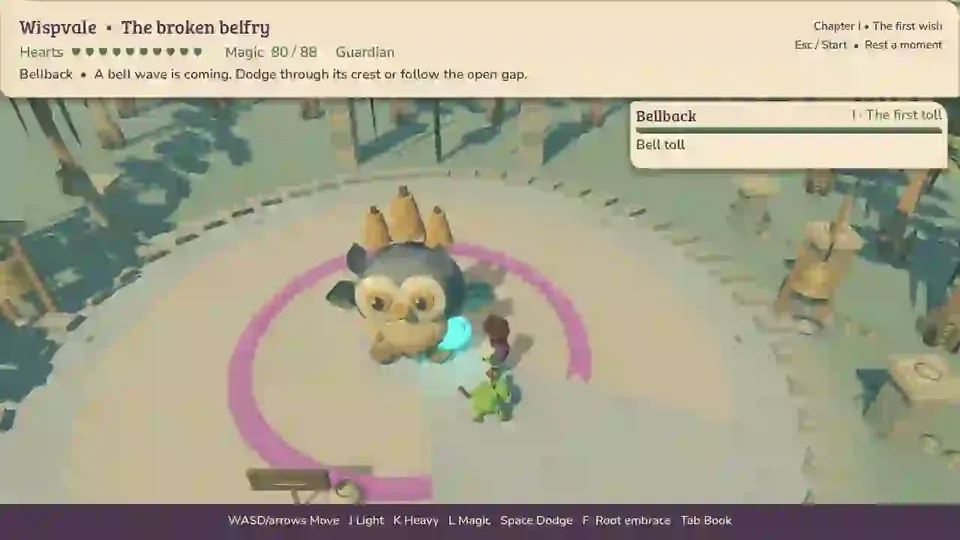
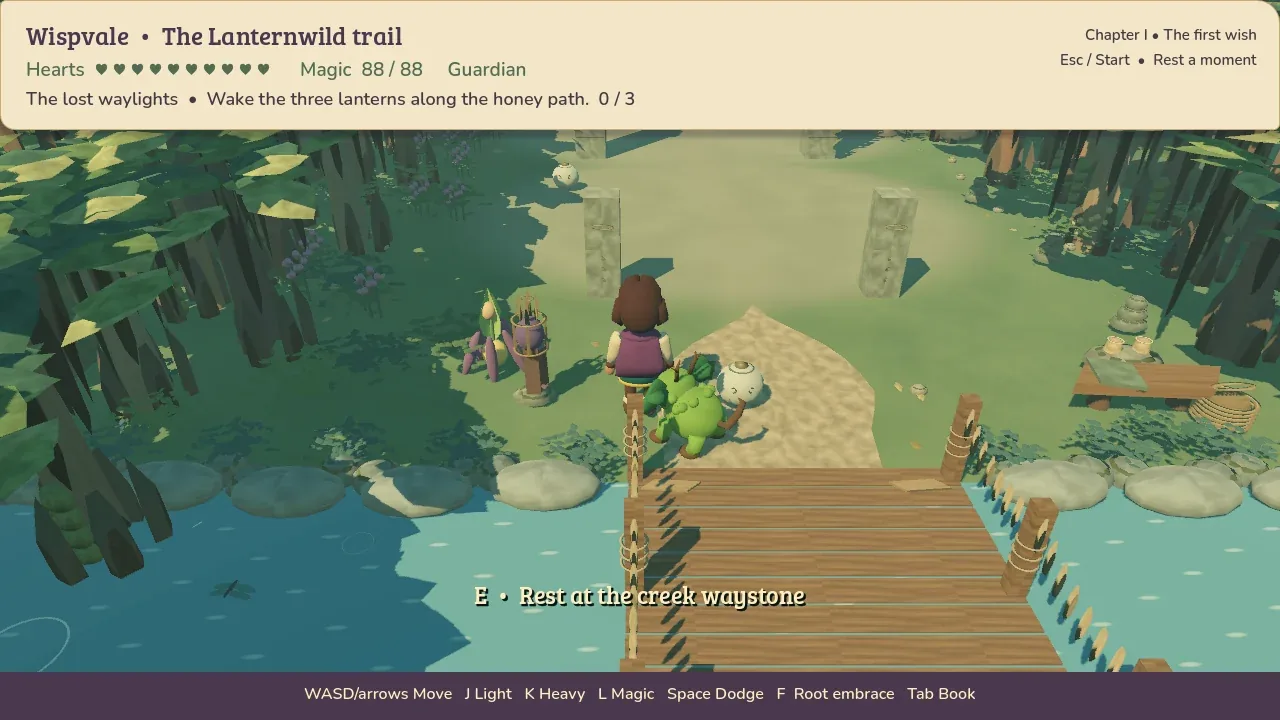
Wispvale in Godot: the hero and a little green companion on a boardwalk in the Lanternwild trail, with the quest line at the top

FACT SHEET

Genre
Top-down fantasy action-adventure
Controls
Keyboard and controller
Engine
Godot 4.7, GDScript
Started as
One offline browser file that grew to 56 maps, 30 quests and 5 bosses
Now
A smaller, painted Chapter I in Godot
Play today
A painted, narrated opening, a garden and cottage, a hall where you pick a class and a companion, the Lanternwild trail, a trials meadow, eight creatures and two guardian fights
Status
In development. No public download yet.

How it grew: one offline browser file became a native Godot adventure

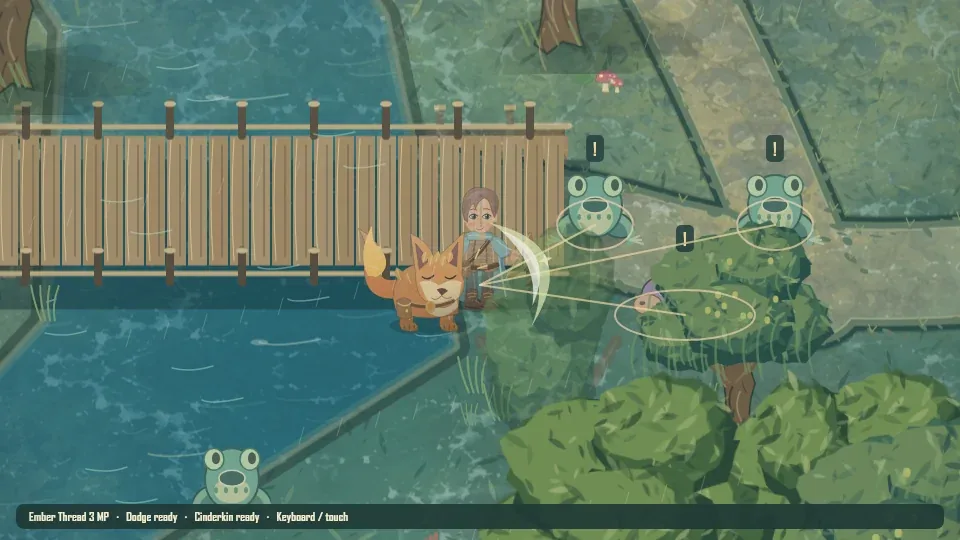
The first browser version of Wispvale: the hero and a fox companion by a wooden bridge, aiming at frog creatures
THENThe first browser version, one offline file.
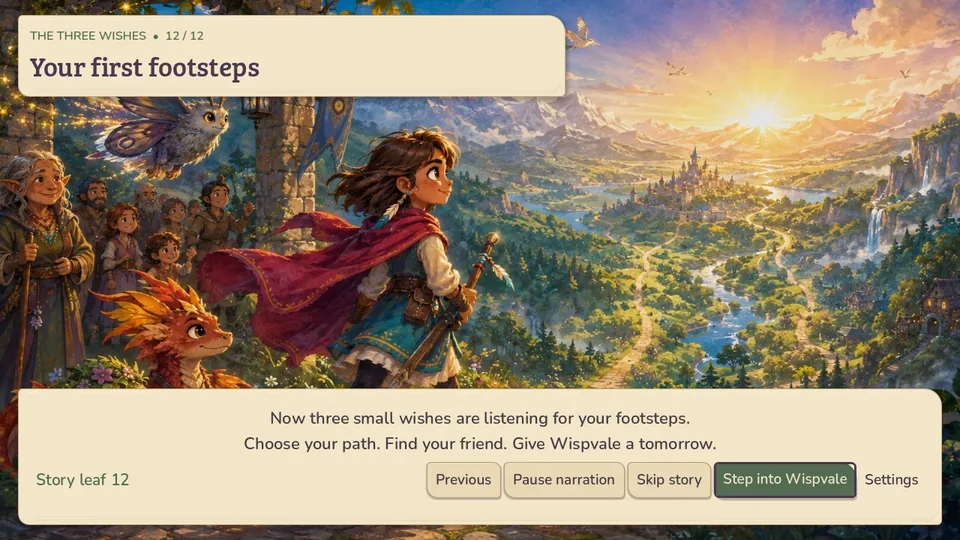
Wispvale's painted opening: a young hero in a red cape looks over a valley with a castle, a dragon friend at her side
NOWA painted, narrated opening.
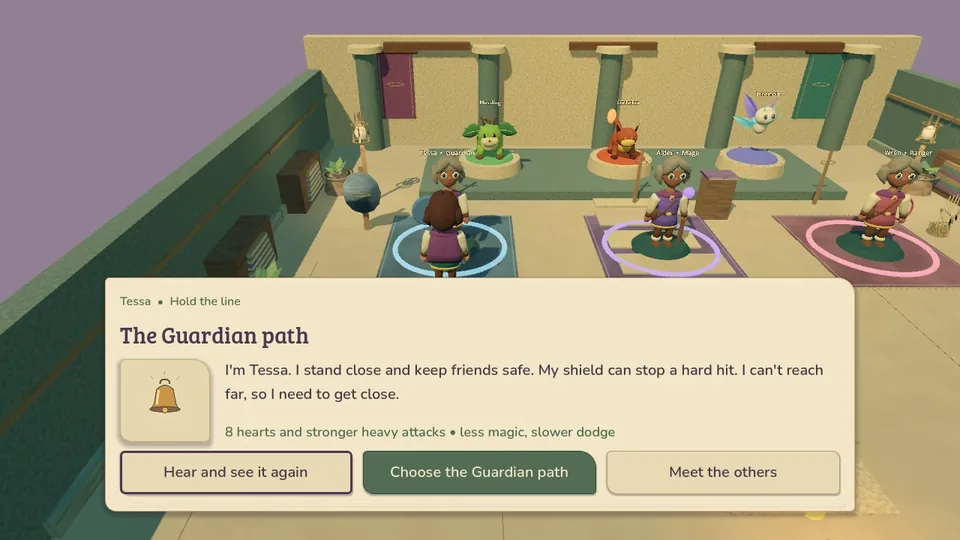
The hall in Wispvale, where you meet the companions and pick a class
PICKA class and a companion, in the hall.
A guardian fight in Wispvale: Bellback sends out a bell wave at the broken belfry
FIGHTBellback, at the broken belfry.
PREVIEWDONE AND PLAYABLE

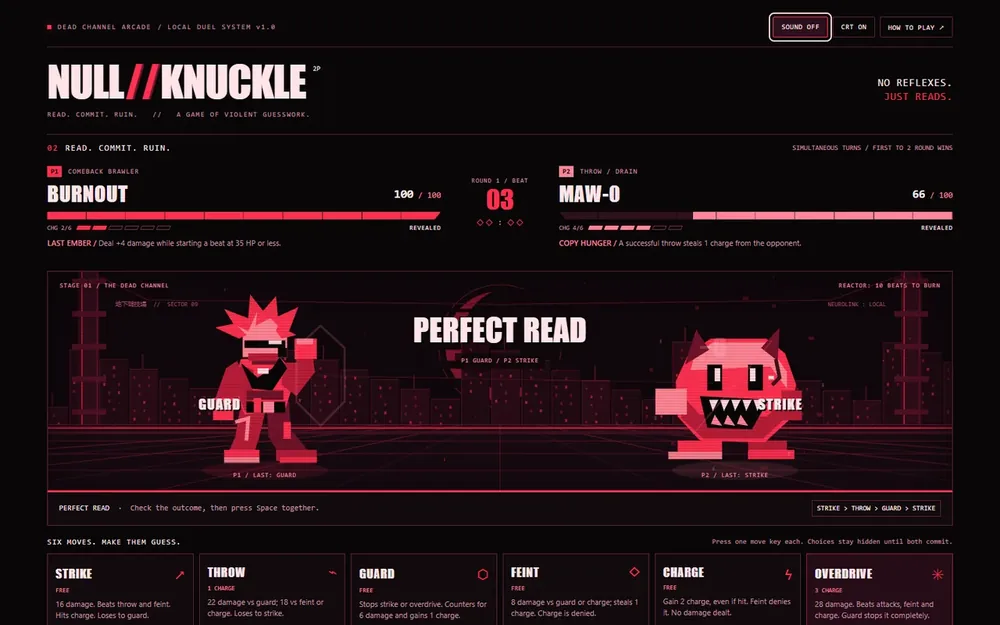
NULL//KNUCKLE

Read. Commit. Ruin.

NULL//KNUCKLE: two fighters face off in red and black, a Perfect Read banner between them, six move cards below
▲Both players pick a move in secret, then reveal.

A two-player mind-game fighter. Both players secretly pick one of six moves (strike, throw, guard, feint, charge, overdrive), then reveal.

  • Ten fighters, first to two rounds
  • One shared keyboard
  • One HTML file, no network, Spanish toggle
  • Balance not playtested by real people yet. A script checked 46,806 matchup scenarios.

Unofficial, non-commercial parody. Not affiliated with any game company.

PREVIEWDONE AND PLAYABLE

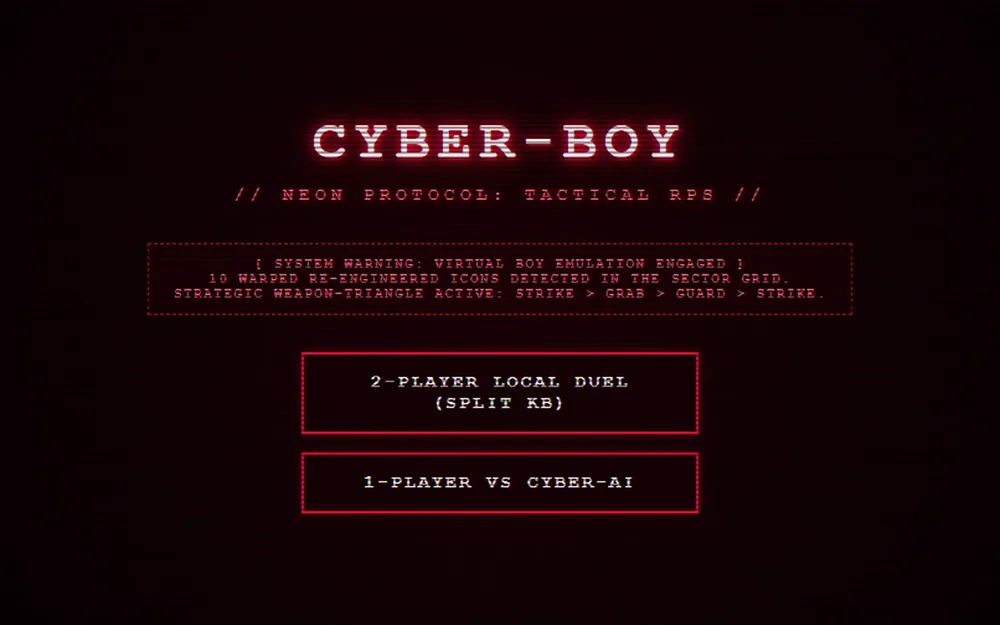
CYBER-BOY // NEON PROTOCOL

Strike beats grab. Grab beats guard. Guard beats strike.

CYBER-BOY title screen in red on black, with buttons for a two-player local duel and one player against the computer
▲Red on black, and both players lock in at once.

A rock-paper-scissors fighter in red on black. Strike beats grab, grab beats guard, guard beats strike, and both players lock in at the same moment.

  • Ten fighters
  • Two players on one keyboard, or one against the computer
  • One HTML file, no network, Spanish toggle
  • I used it as a live demo in a class I taught.

Unofficial, non-commercial parody. Not affiliated with any game company.

54LOADOUT · November 2026Made With the Kit

56ASCIIPAGE 56

ASCII

Games drawn in letters.

Text art has been a game look since the first terminals. This department collects tools that make it move: animated pieces, drawing kits and engines that run on letters. Each entry is one we ran ourselves.

ENTRY 01KEEP

ASCII Magic Art

734 moving pictures made of letters. Free, and free to sell.

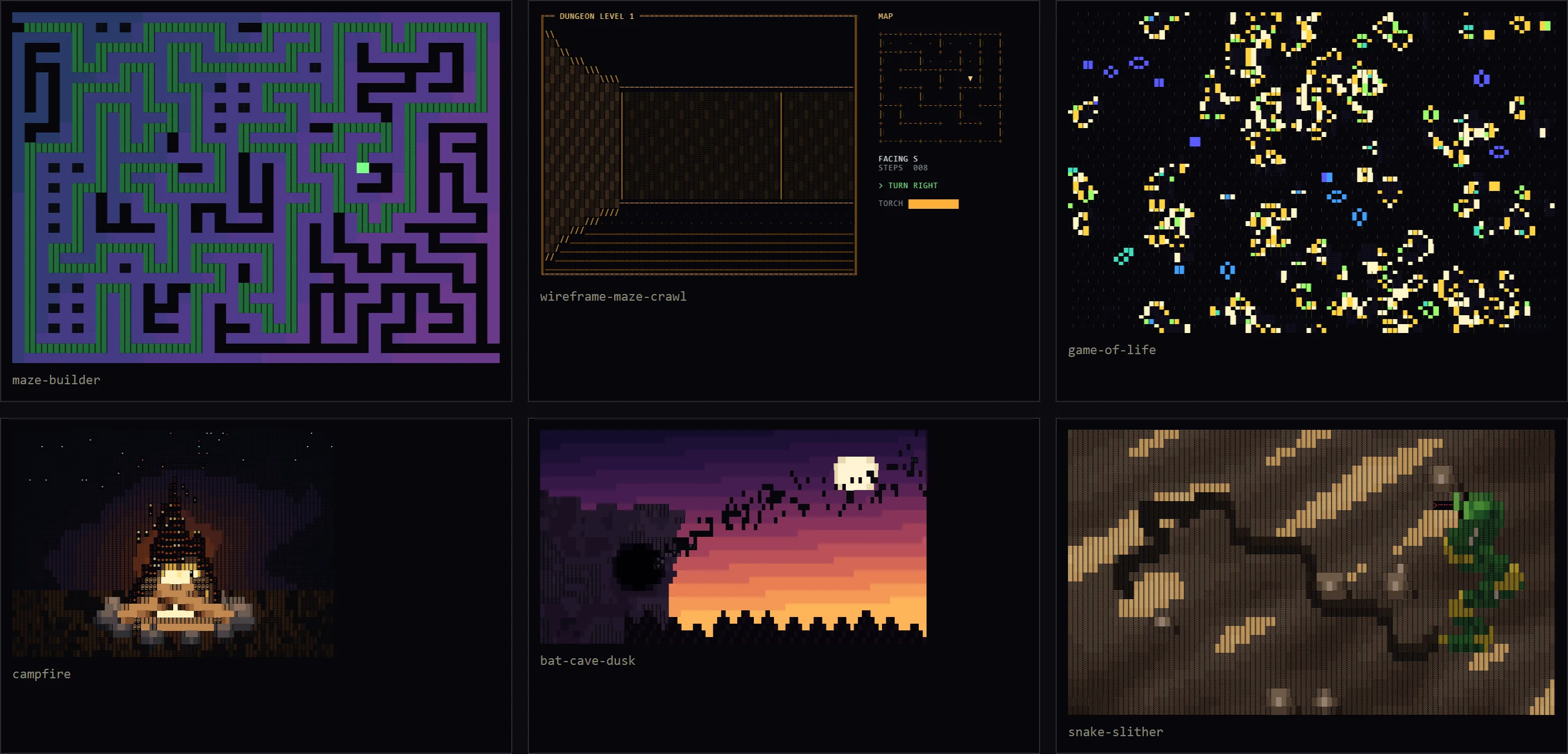
A campfire, a maze builder, a snake, a bat cave at dusk. Each piece is a small animation drawn with text characters, with color. Use one as a web component, or import it and draw it where you like. A small kit in the box (grid, shading, noise, palettes, 3D helpers) lets you draw your own.

What we tested
733 of 734 pieces pass its built-in check. The one that fails is only too slow (20.8 ms a frame, the limit is 12). We ran six pieces at once on a page we hosted ourselves: no errors, and no requests to outside sites. Pieces pause when off screen and hold a still frame for visitors who prefer reduced motion. Then we built a lantern room on the kit: about 80 lines, arrow keys, a key, a locked door and treasure. A scripted walk won it.
Verdict
Keep. Good for title screens, loaders and backdrops, and as a starter kit for an ASCII game.
Self-host tip
The copy-a-prompt button in its command-line tool tells your AI to load the script from ascii-magic.com. Don't. Install the package, pin the version, and serve runtime/, lib/ and only the pieces you use from your own site.
Rough edges
It draws. It is not a game engine, so input, collision and game state are yours. Godot is untested. A few pieces copy famous games closely; leave those out of anything you publish. Two photo scenes use the Unsplash License, not MIT. Pieces draw on a canvas, so a screen reader gets the piece name, not the art.
License
MIT, so you can sell games made with it. Keep the MIT notice.
Six ASCII animations playing side by side on a test page: a maze builder, a wireframe maze crawl, Game of Life, a campfire, a bat cave at dusk and a snake slithering.
Six pieces playing at once on our self-hosted test page.
GitHub Field test

Hand it to your AI

Add ASCII Magic Art from https://github.com/kailashsr38/ascii-magic-art to my game. Install the package and pin the version. Serve runtime/, lib/ and only the pieces I use from my own site. Do not load anything from ascii-magic.com.

More entries coming as we test them.

56LOADOUT · November 2026ASCII

58The Back RoomPAGE 58

The Back Room

Every used game store has a back room. Ours is where the tools live.

We built eight small tools while making our games with AI. They fix boring problems: which test is out of date, who wins too often, which sound was the good one. They're free on GitHub under Apache 2.0, so use them in games you sell too.

Most run from the command line, and we tested them on Windows. Bring patience and your AI.

TOOL 01 / 08GRAB IT

First Player Problem

Does going first win too often? Find out before game night does.

Kids notice when a game is rigged. Usually after the fourth loss in a row.

Write your rules as a small JavaScript file. First Player Problem plays thousands of seeded bot games and gives each seat's win rate with an honest margin of error. Then turn a dial, like a head start for the second player, and see what changes.

On our games
It's the balance check behind Toy Fort Game Night. Before we trusted it, it had to reproduce 37 of 37 saved results exactly. The bots are named after our table: little, big, adult, and adult-kind, the grown-up who won't bump the little one's piece.
Rough edges
Bots aren't people. It tells you who wins, not whether it's fun. Still playtest.
You need
Node 22. That's it.
First Player Problem Comet Race | seed 7 | Wilson 95%
custom | 1000 games | 3.8 min median / 5 p90 | cap hits 0
Seat 1 big 60.6% (57.5% to 63.6%) | Seat 2 big 39.4% (36.4% to 42.5%)
First Player Problem sweep Comet Race | 3 cases | cap hits 0 | Wilson 95%
Case 1 {"finish":12,"secondSeatBoost":0} | cap hits 0 | baseline
Case 2 {"finish":12,"secondSeatBoost":1} | cap hits 0
custom | Seat 1 big 60.6% to 51.8% (real change) | Seat 2 big 39.4% to 48.2% (real change)
Case 3 {"finish":12,"secondSeatBoost":2} | cap hits 0
custom | Seat 1 big 60.6% to 43.6% (real change) | Seat 2 big 39.4% to 56.4% (real change)
A seeded match sweep from the Comet Race example.
GitHub

Hand it to your AI

Set up First Player Problem from https://github.com/thebeefasaurusrex/first-player-problem for my game. Follow its README and run its tests first.

TOOL 02 / 08GRAB IT

ChirpSmith

Make the same "boing" twice.

Generated sound effects are great until you can't get the good one back.

Write each sound as a recipe with a seed. Same recipe, same WAV, byte for byte. ChirpSmith checks for clipping, loudness and dead air.

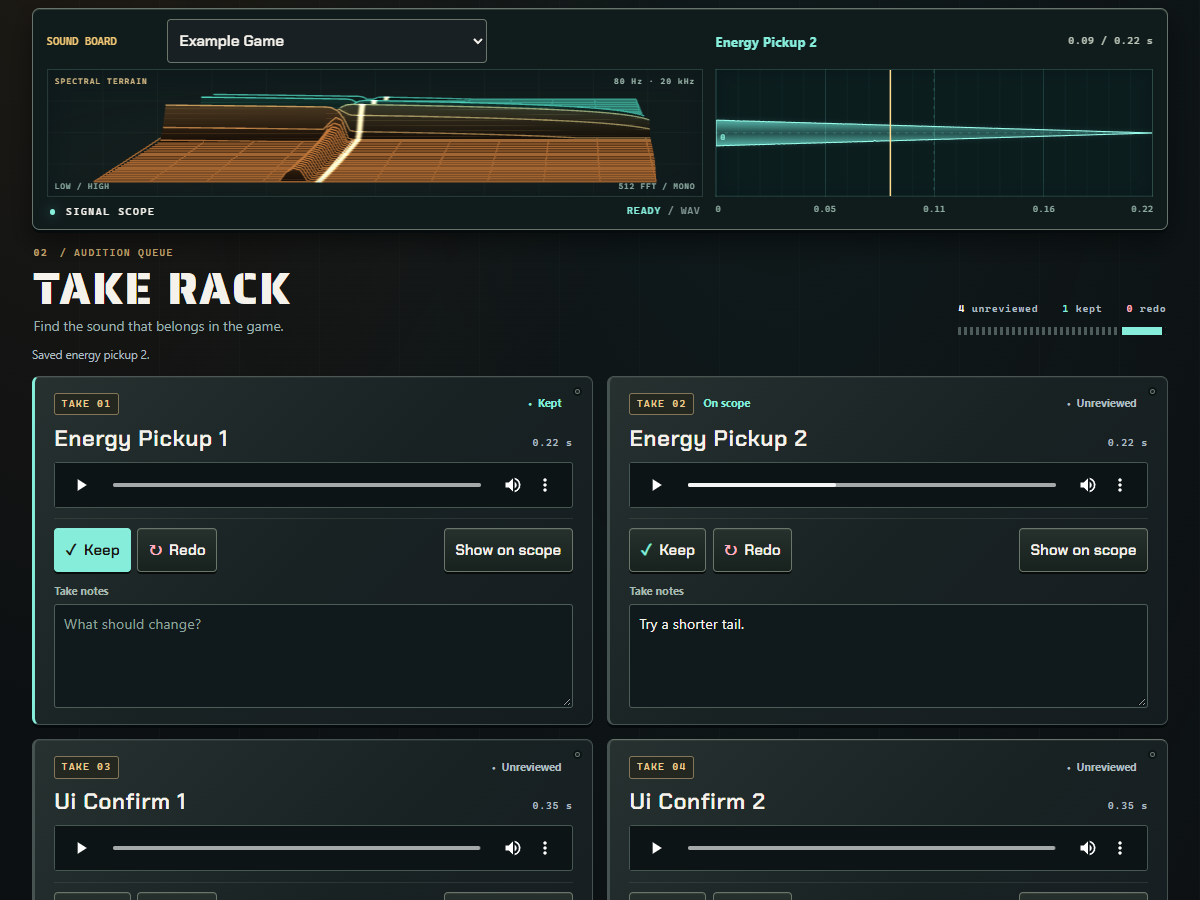
The v0.4.0 workbench keeps the waveform and 3D frequency terrain in view as you scroll the take rack. Switch games in one tab, scrub the waveform or use Show on scope to inspect a take without playing it. Wider cards give your notes four full-width lines. Keep, Redo and notes save with each sound set.

On our games
We auditioned Wispvale's heavy-hit sounds on the board, captured from the real game mix.
Rough edges
Retro synth sounds only (jsfxr and ZzFX). It won't make you a cello.
You need
Node 22 and FFmpeg.
ChirpSmith with its game picker, waveform and 3D terrain pinned above wide take cards with four-line notes.
The ChirpSmith v0.4.0 public demo, scrolled into the take rack. The scope and game picker stay in view.
GitHub

Hand it to your AI

Set up ChirpSmith from https://github.com/thebeefasaurusrex/chirp-smith for my game. Follow its README and run its tests first.

TOOL 03 / 08GRAB IT

PausePostcard

A screenshot that says where the bug is.

"It broke" is not a bug report. "It broke here, on this build" is.

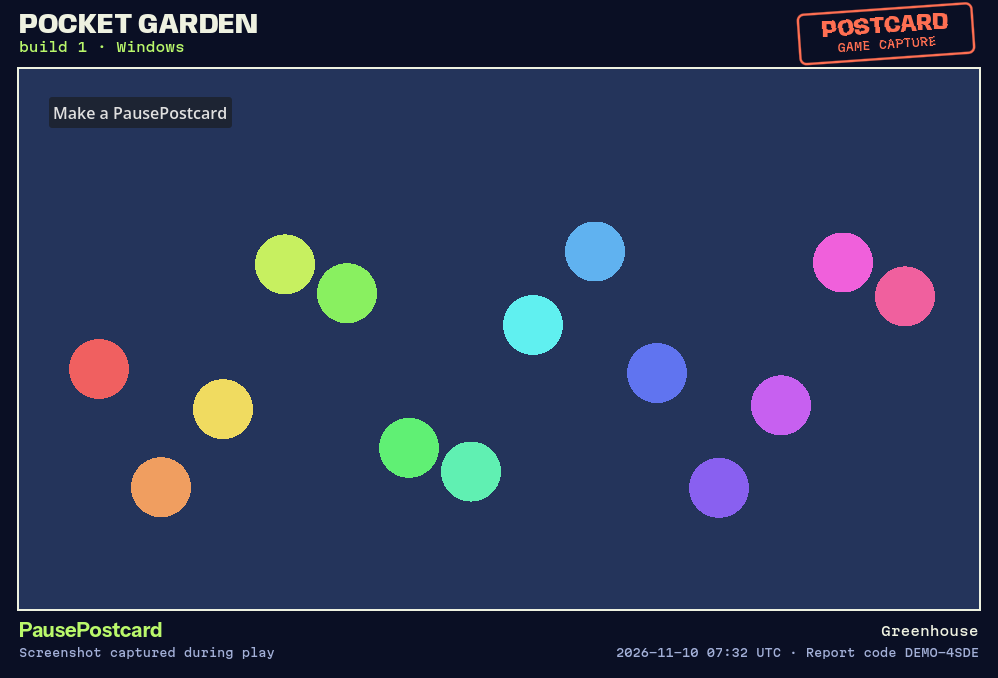
One button frames the game screen like a postcard: the build, where you are in the game, the date and a short report code. The player saves it and sends it if they want to. Nothing uploads on its own. Works in the browser and in Godot.

On our games
It's the camera button on Post Below's play page. Press K.
Rough edges
The game has to tell it where you are. That part's on you.
You need
A browser game or Godot 4.
A postcard captured in the Godot demo.
GitHub

Hand it to your AI

Set up PausePostcard from https://github.com/thebeefasaurusrex/pause-postcard for my game. Follow its README and run its tests first.

TOOL 04 / 08HANDY

RunReceipt

Your tests passed. On which code?

An AI will happily tell you the tests passed. It won't always mention that was before it changed three files.

RunReceipt wraps the Godot checks you already have and saves a receipt tied to the exact source it tested. Change a file and the old receipt goes stale, loudly. You get a short summary instead of a wall of log.

On our games
The last time we ran Wispvale's trail check through it, it was 40 of 40, stamped to the code it tested.
Rough edges
Godot only, and you describe your checks in a small config file first.
You need
Node 22.14 or later and Godot 4.
PASS pass | 1/1 checks
Stamp 5e9d2ee95d4f | Godot 4.7.2.stable.official.ed1daf0bf | headless/gl_compatibility
STALE pass | evidence missing, changed or unavailable
A passing receipt from the sample Godot project.
GitHub

Hand it to your AI

Set up RunReceipt from https://github.com/thebeefasaurusrex/run-receipt for my game. Follow its README and run its tests first.

TOOL 05 / 08HANDY

SceneSift

Where is that function called from? Ask once.

Godot projects scatter logic across scenes and scripts. You, or your AI, end up searching the whole folder again and again.

SceneSift indexes your GDScript, scene files and JavaScript, then answers "where is this defined, and who calls it?" It keeps the index and only rereads files that changed.

On our games
In one side-by-side lookup on Wispvale it answered in 0.83 seconds. The editor plugin we tried took 3.58.
Rough edges
It matches names, not running code, so things that only connect at runtime can fool it.
You need
Node 22.14 or later. You don't even need Godot installed.
Builder.make | 1 definitions | 1 call sites | 0 other references
DEF complex.gd:18-27 | Builder.make | static func make( scene: PackedScene, label: String = "not: the end" ) -> Node:
CALL complex.gd:30 | begin
A symbol lookup in the sample project.
GitHub

Hand it to your AI

Set up SceneSift from https://github.com/thebeefasaurusrex/scene-sift for my game. Follow its README and run its tests first.

TOOL 06 / 08HANDY

Token Taxman

Where did all the tokens go?

AI coding sessions charge you to reread the same files over and over. You don't see it until the bill.

Point Token Taxman at Codex or Claude Code session logs on your own computer. It estimates the weighted token cost and counts repeated work, like reading a file again or running a command twice. No uploads, no network.

On our games
It kept the budget while the AI crew built these tools. The plan said 5.5 million tokens. They came in at 5.39.
Rough edges
Estimates, not your invoice. Log formats change.
You need
Node 22.
> token-taxman codex examples/codex.jsonl
codex | 53 weighted tokens | 2 turns | 1 transcripts
Input 50 | cached 30 | recorded output 6
Repeated file reads: 2
Repeated commands: none
read/search | 100.0% estimated reread share | 2 calls
Weighted token totals from the synthetic Codex example.
GitHub

Hand it to your AI

Set up Token Taxman from https://github.com/thebeefasaurusrex/token-taxman for my game. Follow its README and run its tests first.

TOOL 07 / 08NICHE

PocketParity

Test your Game Boy game on two emulators with one script.

A homebrew cart can behave on one emulator and act weird on another.

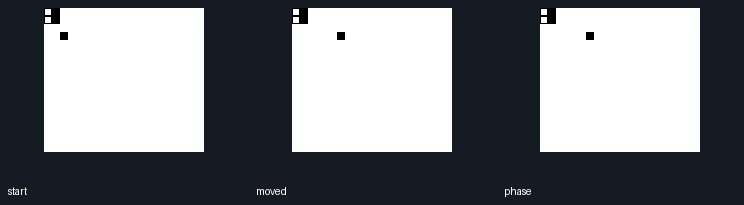
Write a tiny script: wait 60 frames, press A, expect this byte to be 1. PocketParity runs the same script on PyBoy and on Mesen, then saves the numbers, screenshots and a contact sheet.

On our games
On our test cart, both emulators flip the phase 2,099 frames after the mark. Same frame, two emulators.
Rough edges
Setup is a chore: Node, Python 3.13, GBDK and Mesen. Game Boy and Game Boy Color only. Bring your own legal ROM.
You need
Windows (the tested setup) and the list above.

PyBoy contact sheet: the example cart at start, after a move and at the phase flip. The same script runs on Mesen to compare.

The PyBoy contact sheet from the example cartridge.
GitHub

Hand it to your AI

Set up PocketParity from https://github.com/thebeefasaurusrex/pocket-parity for my game. Follow its README and run its tests first.

TOOL 08 / 08EXPERIMENTAL

Pixel Tripwire

Catch black screens, frozen frames and missing-texture pink before a player does.

Nobody watches every screenshot from an overnight test run.

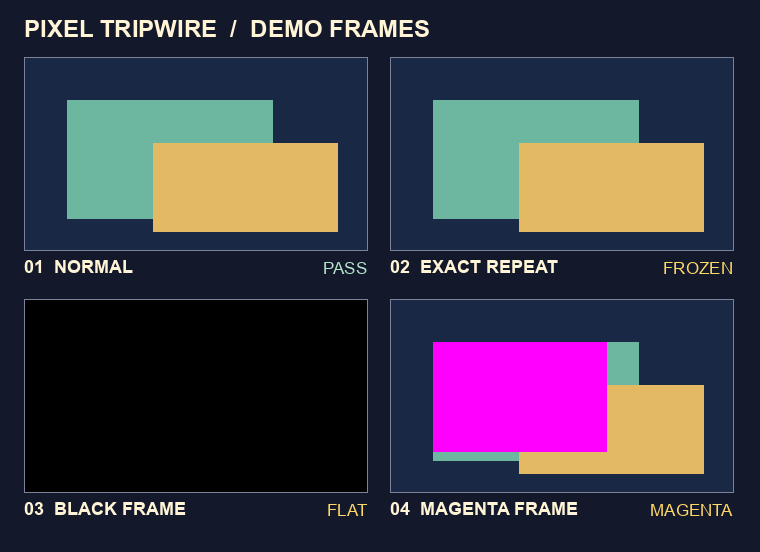
A quick scanner flags frames that are almost flat, an exact repeat of the last one, or full of that bright missing-texture magenta. A scorer grades any detector you bring, AI or not, against frames you labeled yourself.

On our games
We spent two nights asking small local vision AIs to spot broken frames. They mostly said everything looked great. So we kept the plain checks and the scorecard, so you can test your detector before you trust it.
Rough edges
Menus that sit still trip the frozen check, and so do games that love magenta. Tune it.
You need
Python 3.10 and Pillow. Node 22 for the scorer.

Four demo frames: one normal frame that passes, then the three bugs it catches. Frozen, flat black and missing-texture magenta.

The four synthetic frames from the Pixel Tripwire demo.
GitHub

Hand it to your AI

Set up Pixel Tripwire from https://github.com/thebeefasaurusrex/pixel-tripwire for my game. Follow its README and run its tests first.

58LOADOUT · November 2026The Back Room

60Take It To Your AIPAGE 60

Clip and send
to your AI

Your AI can read this whole issue. Hand it the brief at the start of a project, or point it at the data files. No sign-up, no email, nothing to mail.

The LOADOUT pull-out

NO STAMP NEEDED · ALL FILES FREE
  • loadout-brief-for-your-ai.md

    The brief. Every kit, the rules, the I-want-to list and the 351 tools worth knowing, in one Markdown file. Start here.

  • tools.json

    All 653 tools: job, role, kinds of game, license, fun and sell status with notes, and the design verdicts.

  • kits.json

    The 12 kits, the every-game kit and the 72 quick answers, with both license modes on every item.

  • toolkit.csv

    All 653 tools as a spreadsheet.

  • llms.txt

    A short index for AI agents that read the site on their own.

Starter prompt

COPIED!

60LOADOUT · November 2026Take It To Your AI

62Return AddressPAGE 62

Return
address

How this issue was made

Two AI teams did the digging. Claude and Codex each swept GitHub for free game-making tools, then reviewed each other's picks and argued it out. I went through it all and signed off on November 5, 2026.

Every tool here was free to use when we checked. Licenses change, so check the project's own page before you rely on one, especially if you might sell your game.

The design calls in CROSSCHECK come from two judges reading evidence boards, not from running every tool. Audio tools were judged without listening, so every audio verdict stays provisional until someone hears the output.

Questions you might have

Is all of this really free?
The magazine is. Every tool in it was free to use when we checked. Some have a catch if you sell your game, which is what the sticker on the cover is for.
Why no Unity or Unreal?
Both teams skipped Unity, Unreal, GameMaker and the paid "AI MCP" products, on cost and license grounds. They can work. This kit sticks to free.
Can my AI read this page?
Yes. Point it at llms.txt, or attach the brief from the pull-out. That's what it's for.
I found a wrong license or a broken link.
Tell me, please. You can find me at marksalisburyai.com.

Credits

  • Fonts: Archivo, Anton, Barlow Condensed, Courier Prime and Bangers, from Google Fonts, under the SIL Open Font License.
  • Motion: GSAP 3.15 (free standard license).
  • Head to Head backdrop: Paper Shaders 0.0.81 (Apache-2.0).
  • Cover scene: a WebGL shader written for this issue.
  • Screenshots: my own games.
  • Research: Claude and Codex, checked against GitHub and against each other. Get it all from the pull-out.
  • Look: inspired by early 90s game magazines. Every logo, section name and badge here is our own. Full list in CREDITS.md.